
출시Android
QueryDock for ES & OpenSearch
Search, inspect, and manage Elasticsearch and OpenSearch clusters from Android.
제품 정보
About
QueryDock for ES & OpenSearch is an Android-native mobile console for OpenSearch and Elasticsearch clusters — read-first, with guarded writes and data visualization. On connect it auto-detects the engine via version.distribution and shows an engine badge, so the same app works whether your cluster runs OpenSearch or Elasticsearch through their compatible REST APIs. It is built for on-call and SRE moments — glance at cluster health, spot unassigned shards, check node heap, and run a quick search or log query — and narrows the gap with web dashboards using health gauges, shard maps, and sparklines. Built with Kotlin, Jetpack Compose, and Material 3 on an MVVM + Repository architecture over OkHttp.
OpenSearch is a trademark of Amazon Web Services. Elasticsearch is a trademark of Elasticsearch B.V. This app is independent and is not affiliated with, endorsed by, or sponsored by either trademark holder; it provides REST API compatibility only.
Features
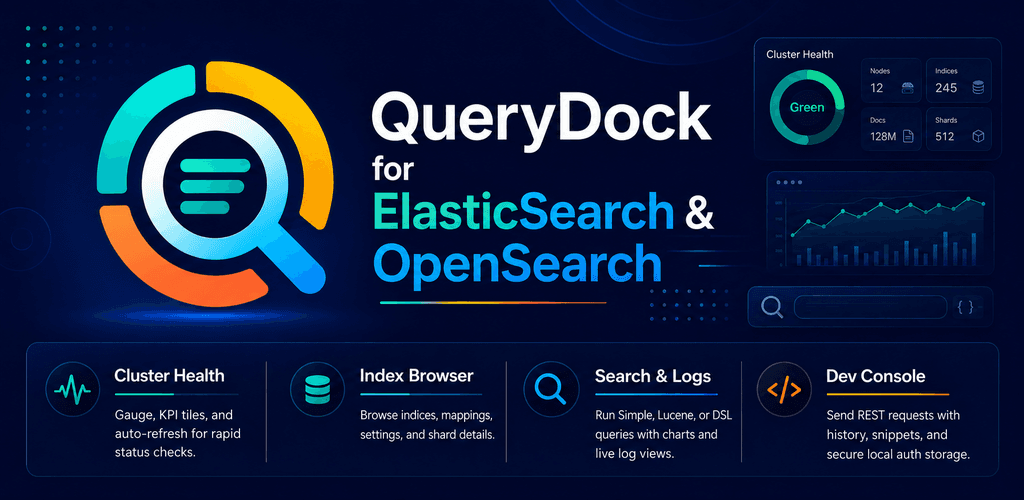
- Cluster Health with a green/yellow/red gauge, KPI tiles (nodes, indices, docs, shards, store), and auto-refresh
- Index Browser: a sortable, filterable index list drilling into Overview, Mappings, Settings, and Shards
- Document Search in Simple, Lucene, or Query DSL mode, with aggregations rendered as charts and infinite scroll
- Document Viewer with a JSON tree and one-tap field copy
- Log Search Mode with an
@timestamptime range, histogram, level/field chips, and live tail - Dev Console for arbitrary REST requests (method/path/body) with history, snippets, and cURL sharing
- Nodes / Shards with heap/cpu/disk sparklines, a shard allocation map, and allocation/explain
- Guarded read-first views for Snapshot, ILM/ISM, Security, and Alerting
- Auth methods (None / Basic / API Key / Bearer) with credentials encrypted by Tink AEAD (AES-256-GCM) and stored locally only, plus an optional allow-self-signed-TLS toggle
- Full English and Korean in-app language selection (System / English / Korean), persisted across launches
설치 및 실행